The decentralized autonomous organization (DAO) governing Jupiter operates at the intersection of decentralized principles and institutional financial rigor. As an industry, DeFi faces the challenge of evolving beyond token-centric speculation into a disciplined framework that balances capital, governance, and community interdependence.
The Solana ecosystem’s key liquidity router exhibits exceptional operational competence, aggregating fragmented trading depth into a unified execution layer with substantial daily volume processing. This technical rigor, however, stands in sharp contrast to a foundational governance subordination, evidenced by the 2025 freeze on voting rights.
An organizational hiatus warrants consideration in regard to the sustainability of the broader DAO ventures within the onchain industry.
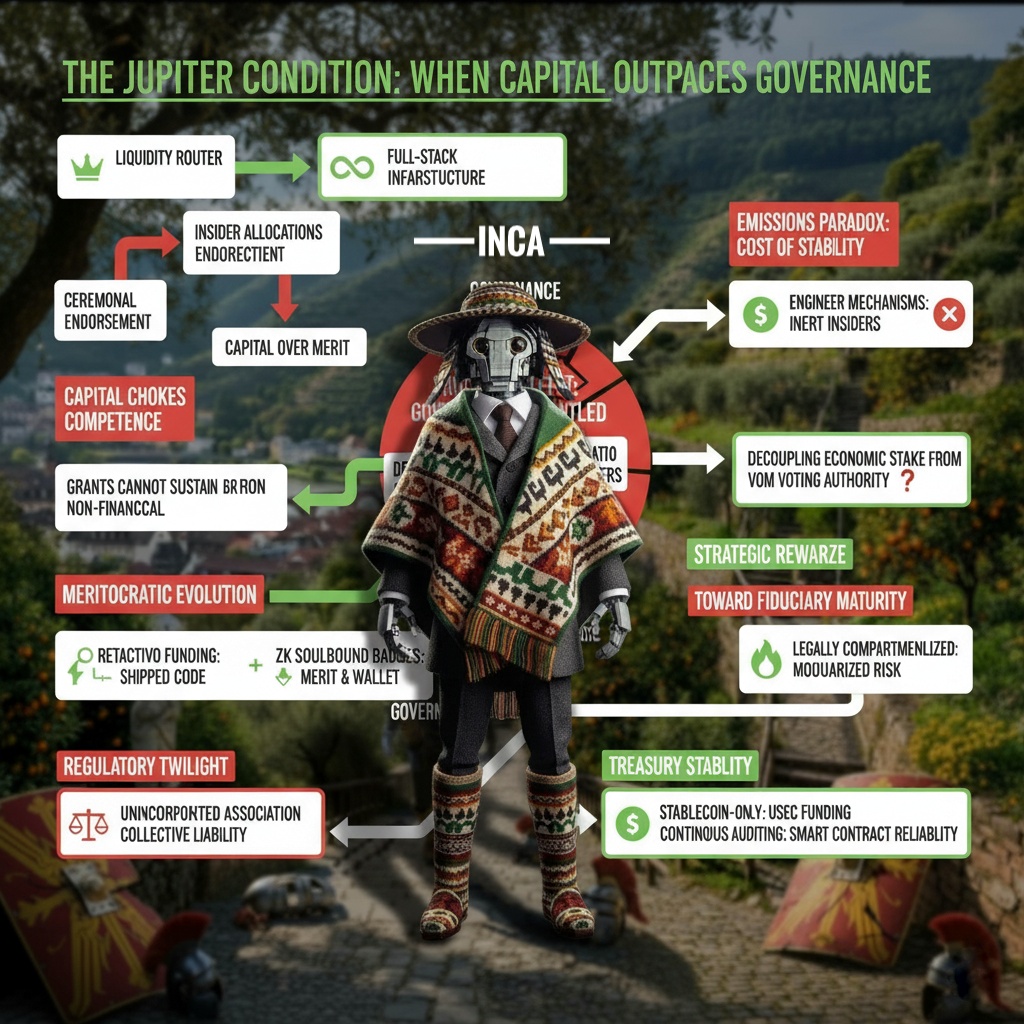
This brief by INCA provides a high-level overview of governance and tokenomics sustainability for $JUP community members and stakeholders.
Governance: Aligning Agency with Capital Weight
The governance architecture reveals an inherent tension: economic stake grants political influence, which, without careful design, can gravitate toward plutocracy. The pause on voting rights raises a key precent in institutional honesty. Core developers assumed concentrated control to redesign governance mechanisms, aiming to fractionalize power and neutralize insider dominance.
The centralized dictatorship is tactically deployed to hopefully transition from oligarchic financial control toward a form of enlightened autocracy. However, the political engine is governed by pragmatic realities rather than ideological purity, reflecting a hybrid reality: startup centralization embedded within a framework aspiring to institutional-grade fiduciary discipline.
The Shifting Burden of Fiduciary Legality
Jupiter DAO operates as an unincorporated association, though its off-chain functions are managed by formalized legal entities. The prospective shift toward legal compartmentalization and role-based indemnification signals an evolution toward decentralized fiduciary maturity, mitigating participants liability while preserving business agility.
The repositioning from alegal to legally framed decentralization, underscores fiduciary prudence amid emerging regulatory expectations.
Incentivizing Merit: The Bureaucracy of Competence
Current grant frameworks, focused on tangible, profitable deliverables, undervalue strategic, long-term funding for decentralized public goods. Alternatives such as retroactive funding and zero-knowledge credentialing show promise but risk creating technocratic gatekeeping to compete with large holders.
The balance between rewarding measurable contributions and fostering high-risk innovation remains unresolved.
The DAO’s affiliate system suggests a potential evolution from simple referral mechanisms into multi-layered networking engines, aiming to incentivize coordination across sub-communities and amplify relational sustainability beyond capital-centric models.
Tokenomics: A Centralized Financial Vehicle
Tokenomics is structured as a centralized financial vehicle, with a capped supply, where half is reserved for team allocations under vesting schedules. The governance freeze coexists with a substantial token reward system to stabilize yield farmers participation. The absence of operational deflationary mechanisms reflects a prioritization of foundation flexibility, maintaining treasury solvency predominantly in stablecoins reserves.
The governance design mirrors a conventional fintech entity’s reliance on internal custodial decisions, where the immutable anchor are trustless smart contracts and periodic audits. The hybrid profile blends multilateral financial stewardship with startup-style political concentration, highlighting governance as a key area for reform.
Benchmarking Jupiter DAO reveals an ecosystem in an oligarchic phase rather than a federated decentralized model. The ongoing governance relaunch aims to dilute insider control by instituting adversarial, performance-bonded delegates, reflecting a live exercise in social contract renegotiation.
Restructuring DeFi DAO: Monarchy or Federation?
Relational sustainability rewards the alignment of fiscal architecture with community decision-making as co-evolving elements of a resilient organism.
Looking ahead, Jupiter’s path forks between federalist self-governance and quasi-monarchical corporate status. The treasury is ample, trusted audits are recurrent, and the DAO’s evolution serves as a microcosm for decentralized governance adapting institutional fiduciary ethics to blockchain-native dynamics.
INCA invites community members and stakeholders to engage with the evolving DeFi landscape as critical participants in a competitive ecosystem, where structural design, fiduciary responsibility, and network incentives converge to define the future of decentralized collaboration.
Copyright © 2025, INCA Technical Research. Reproduction requires a formal licensing agreement.
